The setting
Where and whoCharacters: Olivier and Ni Ni (倪妮), a famous Chinese actress, here as a tourist visiting Paris for the first time and trying to reach the Eiffel Tower. Ni Ni is one of China's best-known actresses (films like The Flowers of War). The bonus chapters feature her as a guest character. As an English-speaking learner you don't need to know who she is — she's just our friendly tourist for this scene.

Olivier
Your teacher — knows the Paris métro like the back of his hand.
Ni Ni · 倪妮
Tourist, completely lost in the métro.
The dialogue
Read along- Ni Ni —Oh, Olivier ! Quelle surprise ! Tu peux m'aider, s'il te plaît ? Je suis perdue. Oh, Olivier! What a surprise! Can you help me please? I'm lost.
- Olivier —Bonjour Ni Ni ! Bien sûr. Tu vas où ? Hi Ni Ni! Of course. Where are you headed?
- Ni Ni —Je vais à la Tour Eiffel. C'est par où ? I'm going to the Eiffel Tower. Which way is it?
- Olivier —Alors, on est ici, à Saint-Michel. Prends la ligne 4, direction Porte de Clignancourt. OK, we're here at Saint-Michel. Take line 4, direction Porte de Clignancourt.
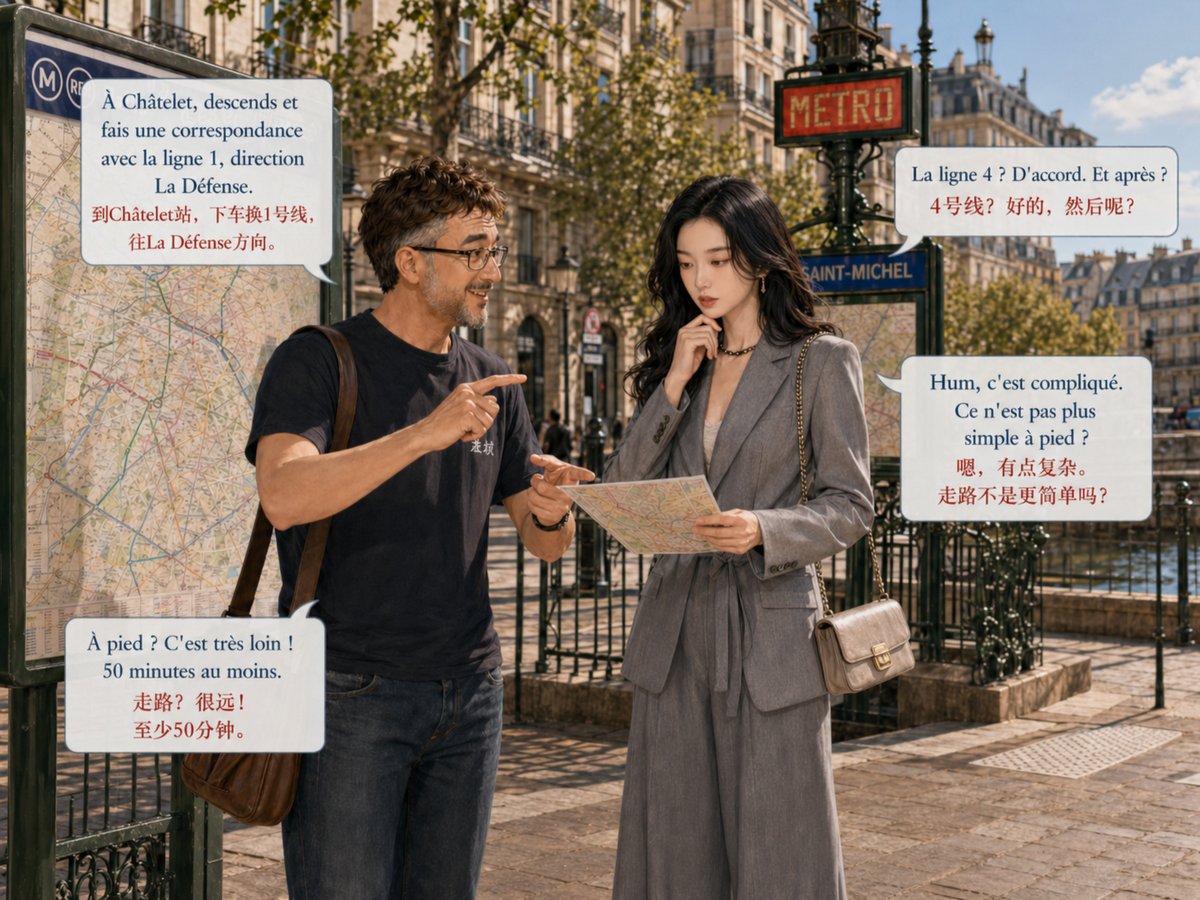
- Ni Ni —La ligne 4 ? D'accord. Et après ? Line 4? OK. And then?
- Olivier —À Châtelet, descends et fais une correspondance avec la ligne 1, direction La Défense. At Châtelet, get off and switch to line 1, direction La Défense.
- Ni Ni —Hum, c'est compliqué. Ce n'est pas plus simple à pied ? Hmm, that's complicated. Wouldn't it be simpler on foot?
- Olivier —À pied ? C'est très loin ! 50 minutes au moins. On foot? It's very far! At least 50 minutes.
- Ni Ni —Ah ! Et avec un Vélib' ? Oh! What about a Vélib' (city bike)?
- Olivier —Bonne idée ! Il y a une station au coin de la rue. Tu prends les quais de la Seine, tu vas tout droit, et après 20 minutes, tu y es ! Great idea! There's a station at the corner of the street. Take the Seine embankments, go straight on, and 20 minutes later you're there!
- Ni Ni —Parfait ! Tu viens avec moi ? Perfect! Are you coming with me?
- Olivier —Avec plaisir ! C'est une belle journée pour faire du vélo. With pleasure! It's a beautiful day for cycling.
- Ni Ni —Allons-y ! Let's go!

3 new words
Just three to learnEverything else comes from Lessons 9 to 12.
-
une ligne
n.f.
a (metro/bus) line; a line (drawn)
The Paris métro has 16 lines.
Ex.: Prends la ligne 4, direction Porte de Clignancourt. -
une correspondance
n.f.
a transfer / change (between metro lines); also: correspondence (letters)
To change lines on the métro, you "make a correspondence" — i.e. transfer.
Ex.: Fais une correspondance à Châtelet. -
les quais
n.m.pl.
embankments (along a river); also: train/metro platforms
The walkways along a river. Same word for the platforms in a métro or train station.
Ex.: Les quais de la Seine sont très romantiques. "The banks of the Seine are very romantic."
Comprehension
Did you follow?True or false? Vrai ou faux ?
1. Ni Ni knows Paris well.
2. Ni Ni wants to go to the Eiffel Tower.
3. Olivier first suggests métro line 4.
4. On foot, it's 20 minutes.
5. They eventually decide to go by Vélib'.
6. Olivier goes with her.
Pick the right answer
- Which line does Olivier suggest first?
- At which station do you change lines?
- How long by Vélib'?
- What does Ni Ni finally suggest?
The Paris métro
A short cultural note🚇 One of the oldest and densest metro systems in the world
Opened in 1900 for the World's Fair, the Paris métro now has 16 lines and over 300 stations. Its Art Nouveau station entrances designed by Hector Guimard are an iconic Paris symbol.
- Each line has a number and a colour: line 1 (yellow), line 4 (purple), line 14 (mauve)…
- You always say "direction" + the name of the terminus: direction Château de Vincennes. (No "northbound/southbound" like in NYC or London — it's the end-station name that tells you which way to ride.)
- To change lines: make a correspondance (transfer).
- Famous stations: Châtelet, Saint-Michel, Concorde, Bastille, Opéra, Louvre-Rivoli…
- A single ticket costs about €2. The Navigo pass is much better value if you're staying a while.
💡 Vélib' is Paris's public bike-share scheme (since 2007). Over 20,000 bikes at 1,400 stations across Paris and inner suburbs. The first 30 minutes are free with a day pass — perfect for short trips. (Similar to London's "Boris Bikes" / Santander Cycles, or NYC's Citi Bike.)