The setting
Where and whoCharacters: Ivy (a teacher friend) is having coffee with her friend Song Yi (宋轶), who's come over for the morning. They're chatting about their daily schedules. Song Yi (宋轶) is a Chinese actress; the bonus chapters feature her as a guest character. As an English-speaking learner you don't need to know who she is to enjoy the dialogue.
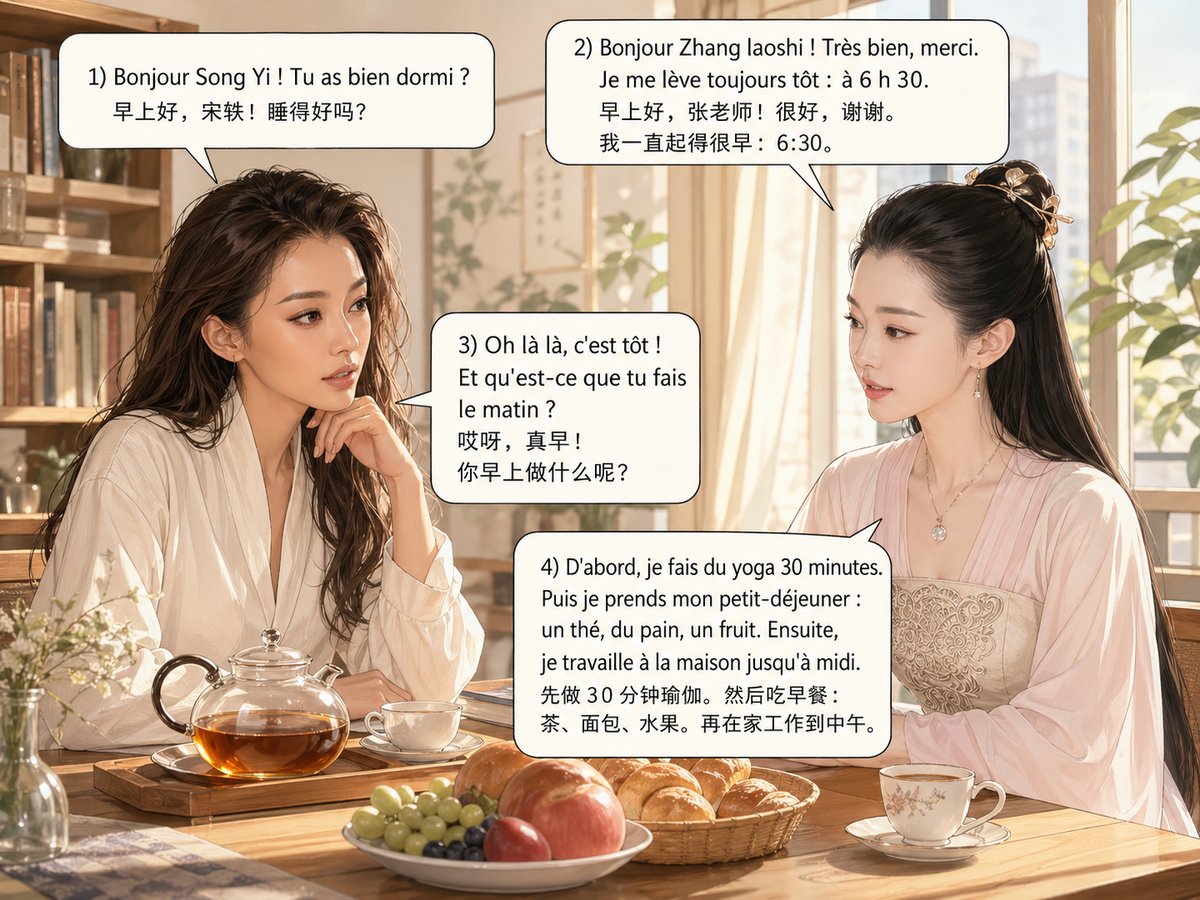
Ivy
A French teacher. Has class today at 2 PM.
Song Yi · 宋轶
Chinese actress. Working from home this morning.
The dialogue
Read along- Ivy —Bonjour Song Yi ! Tu as bien dormi ? Good morning, Song Yi! Did you sleep well?
- Song Yi —Bonjour Ivy ! Très bien, merci. Je me lève toujours tôt : à 6 h 30. Morning, Ivy! Very well, thanks. I always get up early — at 6:30.
- Ivy —Oh là là, c'est tôt ! Et qu'est-ce que tu fais le matin ? Wow, that IS early! And what do you do in the morning?
- Song Yi —D'abord, je fais du yoga 30 minutes. Puis je prends mon petit-déjeuner : un thé, du pain, un fruit. Ensuite, je travaille à la maison jusqu'à midi. First, I do 30 minutes of yoga. Then I have breakfast: tea, bread, a piece of fruit. After that, I work from home until noon.
- Ivy —Et l'après-midi ? And in the afternoon?
- Song Yi —L'après-midi, je vais au bureau de 14 h à 18 h. Et toi, qu'est-ce que tu fais aujourd'hui ? In the afternoon, I go to the office from 2 to 6 PM. What about you — what are you doing today?
- Ivy —Aujourd'hui, j'ai un cours à 14 h, à l'Institut français. Le matin, je prépare le cours. Et puis, je corrige les devoirs des étudiants. Today I have a class at 2 PM at the Institut français. In the morning, I prep the class. Then I grade the students' homework.
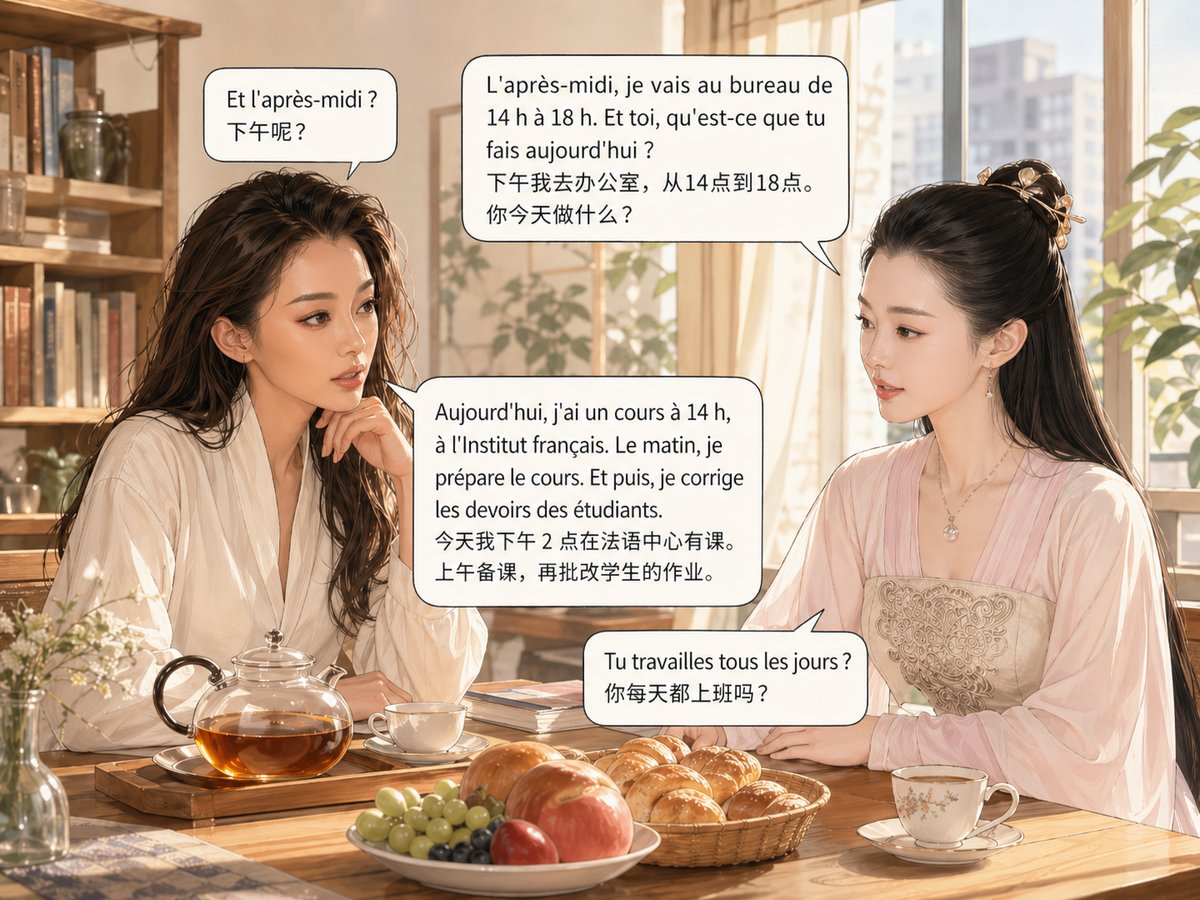
- Song Yi —Tu travailles tous les jours ? Do you work every day?
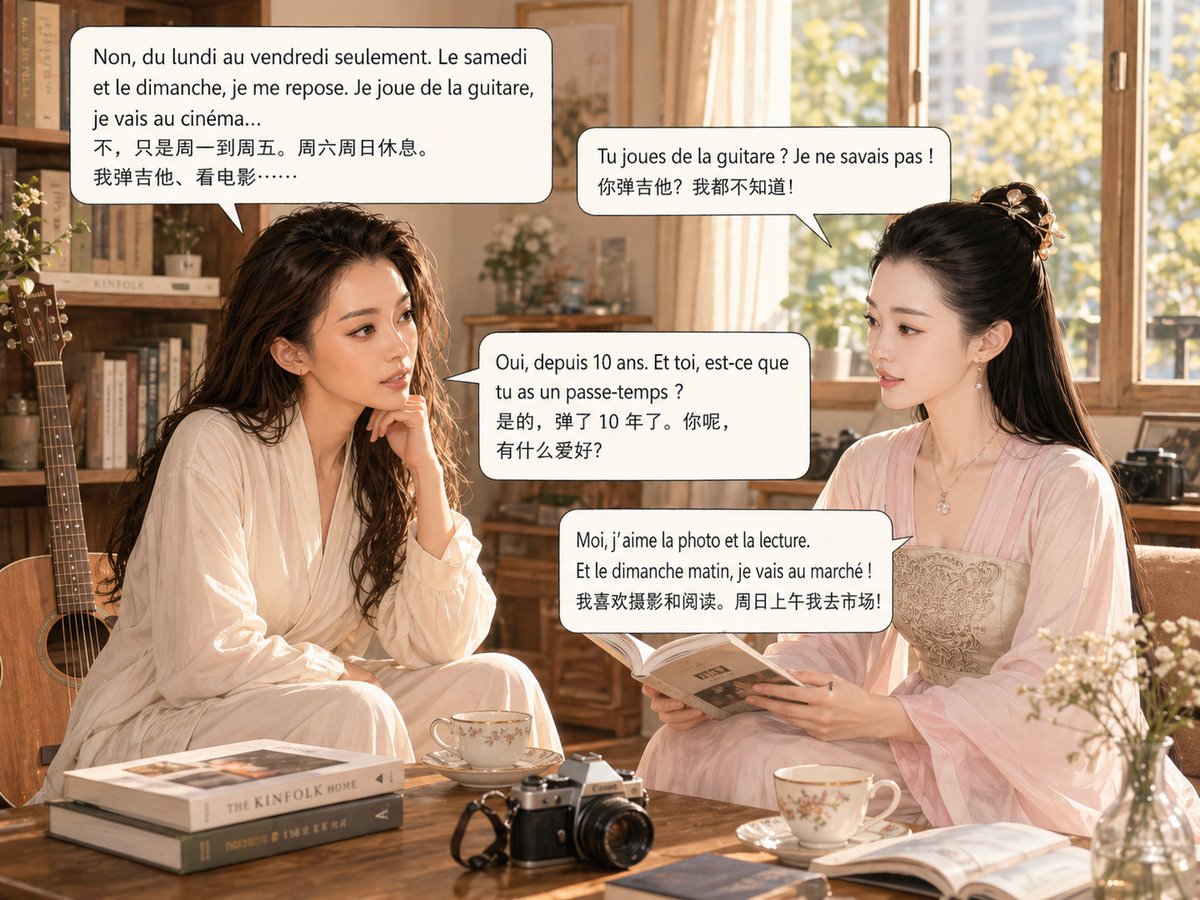
- Ivy —Non, du lundi au vendredi seulement. Le samedi et le dimanche, je me repose. Je joue de la guitare, je vais au cinéma… No, only Monday to Friday. On Saturdays and Sundays I rest. I play guitar, I go to the cinema…
- Song Yi —Tu joues de la guitare ? Je ne savais pas ! You play guitar? I had no idea!
- Ivy —Oui, depuis 10 ans. Et toi, est-ce que tu as un passe-temps ? Yes, for 10 years now. And you — do you have a hobby?
- Song Yi —Moi, j'aime la photo et la lecture. Et le dimanche matin, je vais au marché ! I love photography and reading. And on Sunday mornings I go to the market!
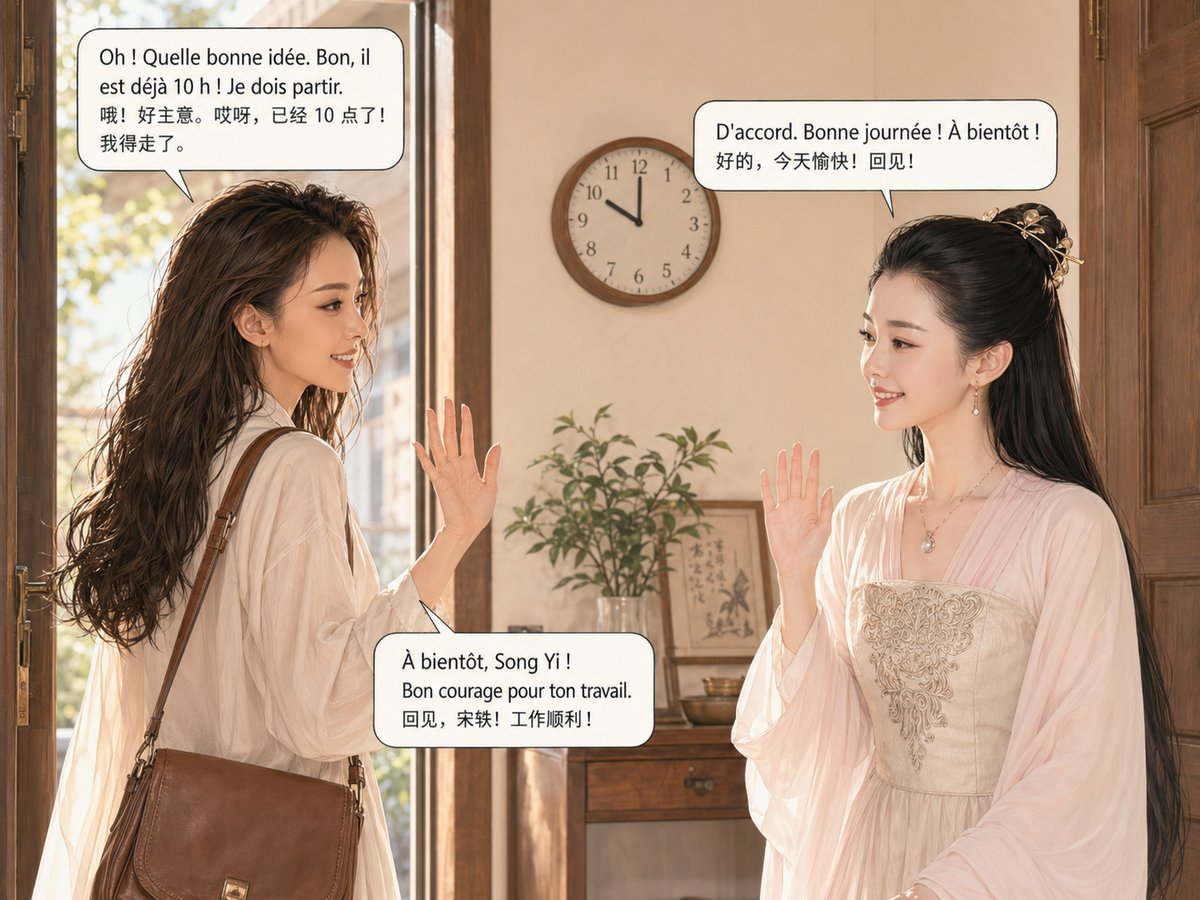
- Ivy —Oh ! Quelle bonne idée. Bon, il est déjà 10 h ! Je dois partir. Oh! Lovely idea. Right, it's already 10 AM! I need to head off.
- Song Yi —D'accord. Bonne journée ! À bientôt ! Okay. Have a great day! See you soon!
- Ivy —À bientôt, Song Yi ! Bon courage pour ton travail. See you soon, Song Yi! Good luck with your work.
3 new words
Just three to learnAll the rest of the vocabulary comes from Lessons 13 to 16.
-
tôt / tard
adv.
early / late
Opposite adverbs. Tôt = before the usual time. Tard = after.
Ex.: Je me lève tôt (à 6 h). · Je me couche tard (à 1 h). -
corriger
v.
to correct, to grade (homework)
Regular -er verb (1st group). A teacher's daily form!
Ex.: Je corrige les devoirs. · Tu corriges mes erreurs ? -
un passe-temps
n.m.
hobby, pastime
An activity you do for fun, to relax. Common synonym: un hobby (borrowed from English).
Ex.: Mon passe-temps préféré, c'est la photo.
Did you follow?
ComprehensionTrue or false? Vrai ou faux ?
Based on the dialogue, decide whether each statement is true or false.
1. Song Yi se lève à 6 h 30.
2. Song Yi fait du yoga le matin.
3. Song Yi travaille au bureau toute la journée.
4. Ivy a un cours à 14 h.
5. Ivy joue de la guitare depuis 10 ans.
6. Song Yi va au marché le samedi.
Pick the right answer
- What is Song Yi's hobby?
- Which days does Ivy work?
- How long does Song Yi do yoga for?
- What does Ivy do in the morning before her class?
- What time does Ivy have to leave?
The French daily rhythm
Later than you might expect☕ A typical day in France
- ~ 7 AM — breakfast (quick: coffee, croissant, orange juice)
- ~ 9 AM — start of work / classes
- 12-2 PM — lunch break (1-2 hours, sometimes more!)
- ~ 6-7 PM — end of the workday
- ~ 8 PM — dinner (later than in the US/UK)
- ~ 11 PM — bedtime
In general, the French day runs later than in the US or UK. Lunch is longer, and dinner is late. In the morning, many French have a very simple breakfast at home or at a café — there's no big "American breakfast" tradition.
💡 Useful phrase: French has no exact equivalent of English "good luck" for everyday work — instead, they say « Bon courage ! » (literally "good courage") or « Bonne journée ! » ("good day") to someone heading off to work.
Before a meal: « Bon appétit ! » — there's nothing quite like it in English; you just say "enjoy!" or nothing at all.