The setting
Where and whoCharacters: Peng Xiaoran (彭小苒) and Zhong Yating (钟雅婷) are two Chinese students who've spent a year studying in France. They're flying back to Beijing tonight — their academic year is over! Olivier has come up from Strasbourg to say goodbye one last time and bring them a small gift each. As an English-speaking learner, you don't need to know who Peng Xiaoran and Zhong Yating are to enjoy the dialogue — these bonus chapters feature Chinese guest characters (often actresses; here, two Chinese student characters) because the website also has a Chinese-targeted version. Just enjoy the airport scene!
Olivier
Your teacher. Came up to Roissy from Strasbourg to say a proper goodbye, with a small gift for each of them.
Peng Xiaoran · 彭小苒
Modern literature student, originally from Chengdu. Torn between staying in China and coming back to France for a master's at the Sorbonne.
Zhong Yating · 钟雅婷
Soon-to-be graduate in fashion and marketing. About to start working in Shanghai for a major French fashion brand.
The dialogue
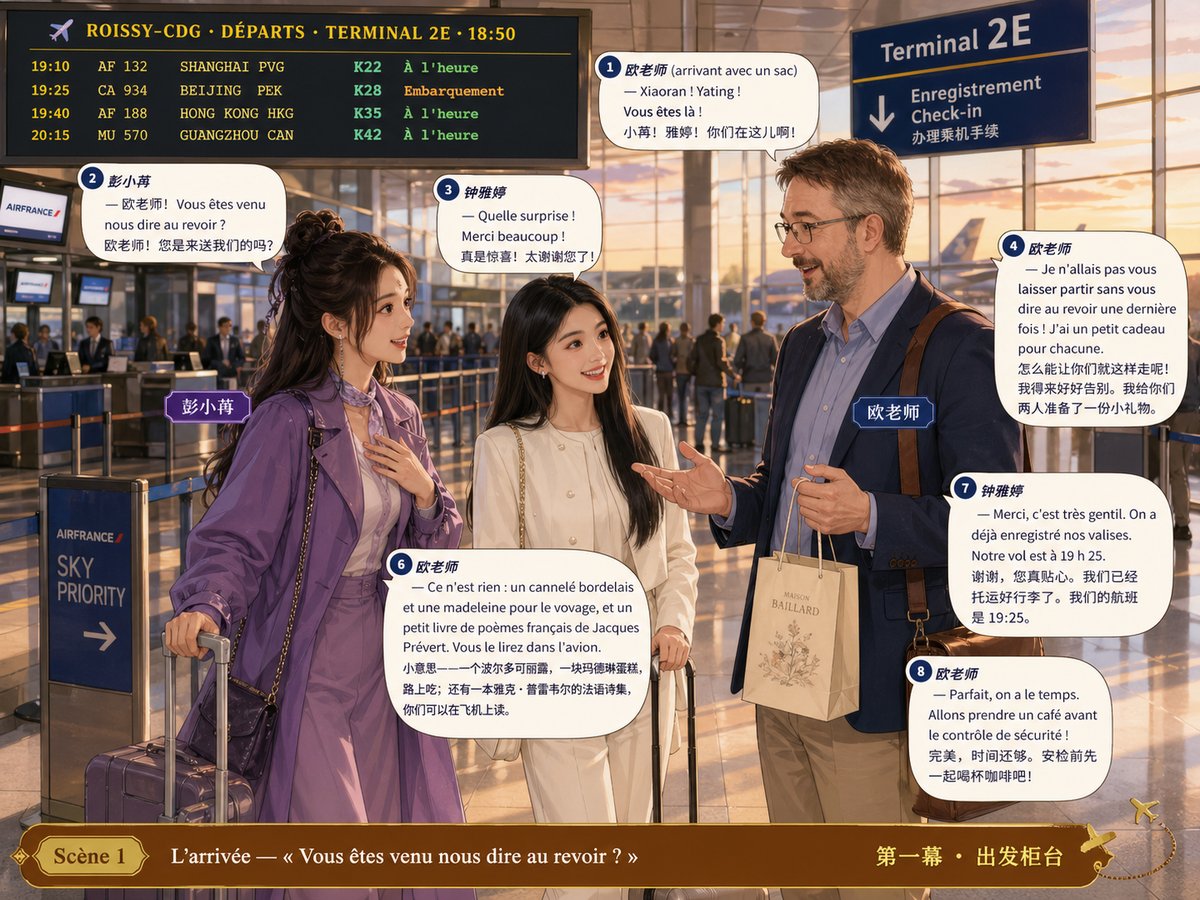
Read along- Olivier (arriving with a bag) —Xiaoran ! Yating ! Vous êtes là ! Xiaoran! Yating! There you are!
- Xiaoran —Olivier ! Vous êtes venu nous dire au revoir ? Olivier! You came to say goodbye?
- Yating —Quelle surprise ! Merci beaucoup ! What a surprise! Thank you so much!
- Olivier —Je n'allais pas vous laisser partir sans vous dire au revoir une dernière fois ! J'ai un petit cadeau pour chacune. I wasn't going to let you leave without saying goodbye one last time! I have a small gift for each of you.
- Xiaoran —Oh, vous n'auriez pas dû ! Oh, you shouldn't have!
- Olivier —Ce n'est rien : un cannelé bordelais et une madeleine pour le voyage, et un petit livre de poèmes français de Jacques Prévert. Vous le lirez dans l'avion. It's nothing: a cannelé from Bordeaux and a madeleine for the journey, and a little book of French poems by Jacques Prévert. You can read it on the plane.
- Yating —Merci, c'est très gentil. On a déjà enregistré nos valises. Notre vol est à 19 h 25. Thanks, that's so thoughtful. We've already checked in our bags. Our flight is at 19:25 (7:25 pm).
- Olivier —Parfait, on a le temps. Allons prendre un café avant le contrôle de sécurité ! Perfect, we have time. Let's grab a coffee before security!
✈️ ROISSY-CDG · DEPARTURES · TERMINAL 2E · 18:50
| 19:10 | AF 132 | SHANGHAI PVG | K22 | On time |
| 19:25 | CA 934 | BEIJING PEK | K28 | Boarding |
| 19:40 | AF 188 | HONG KONG HKG | K35 | On time |
| 20:15 | MU 570 | GUANGZHOU CAN | K42 | On time |
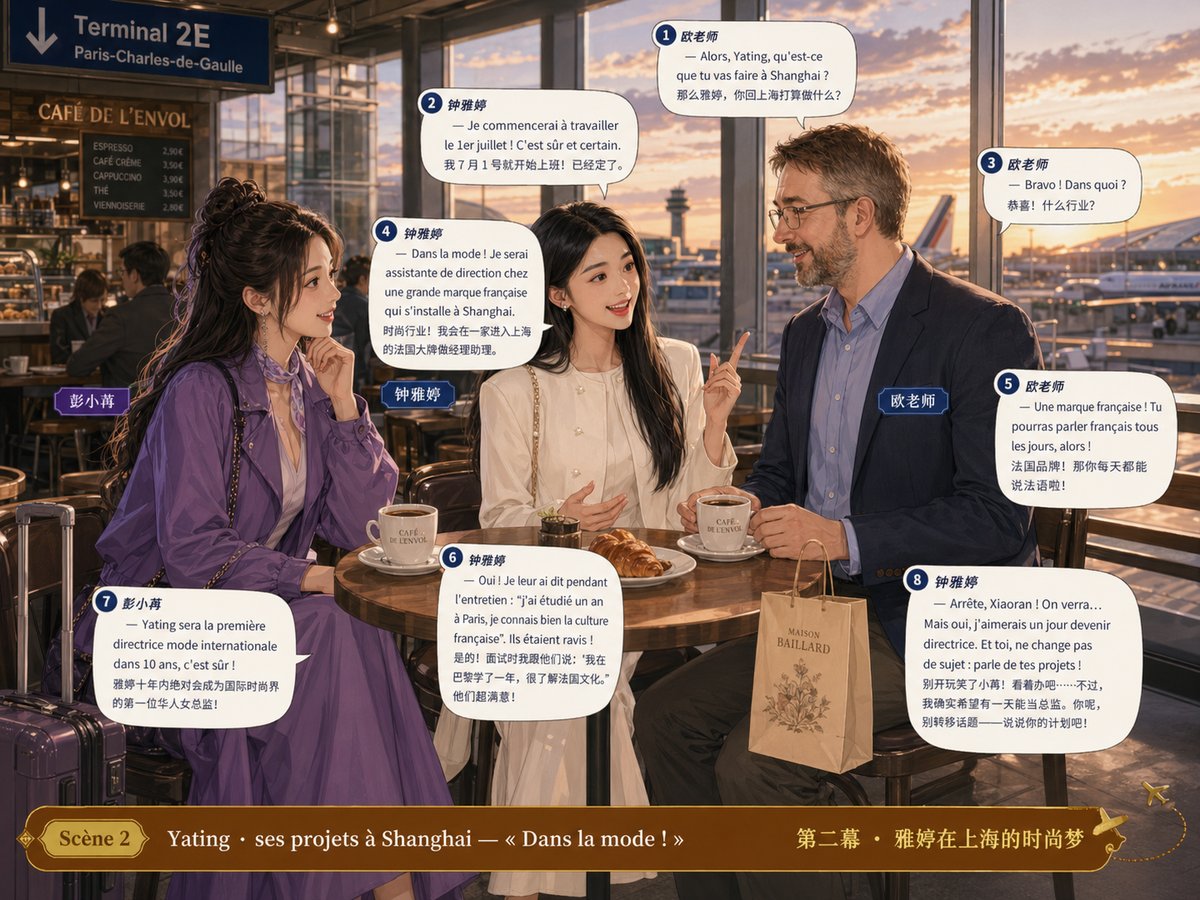
- Olivier (at the café) —Alors, Yating, qu'est-ce que tu vas faire à Shanghai ? So, Yating, what are you going to do in Shanghai?
- Yating —Je commencerai à travailler le 1er juillet ! C'est sûr et certain. I'll start work on July 1st! It's all set.
- Olivier —Bravo ! Dans quoi ? Well done! Doing what?
- Yating —Dans la mode ! Je serai assistante de direction chez une grande marque française qui s'installe à Shanghai. In fashion! I'll be an executive assistant at a major French brand setting up in Shanghai.
- Olivier —Une marque française ! Tu pourras parler français tous les jours, alors ! A French brand! So you'll be able to speak French every day!
- Yating —Oui ! Je leur ai dit pendant l'entretien : "j'ai étudié un an à Paris, je connais bien la culture française". Ils étaient ravis ! Yes! I told them in the interview: "I studied a year in Paris, I know French culture well." They were thrilled!
- Xiaoran (teasing) —Yating sera la première directrice mode internationale dans 10 ans, c'est sûr ! Yating will be the first international fashion director in 10 years, for sure!
- Yating (laughing) —Arrête, Xiaoran ! On verra… Mais oui, j'aimerais un jour devenir directrice. Et toi, ne change pas de sujet : parle de tes projets ! Stop, Xiaoran! We'll see… But yes, I'd love to become a director one day. And you — don't change the subject: tell us about your plans!
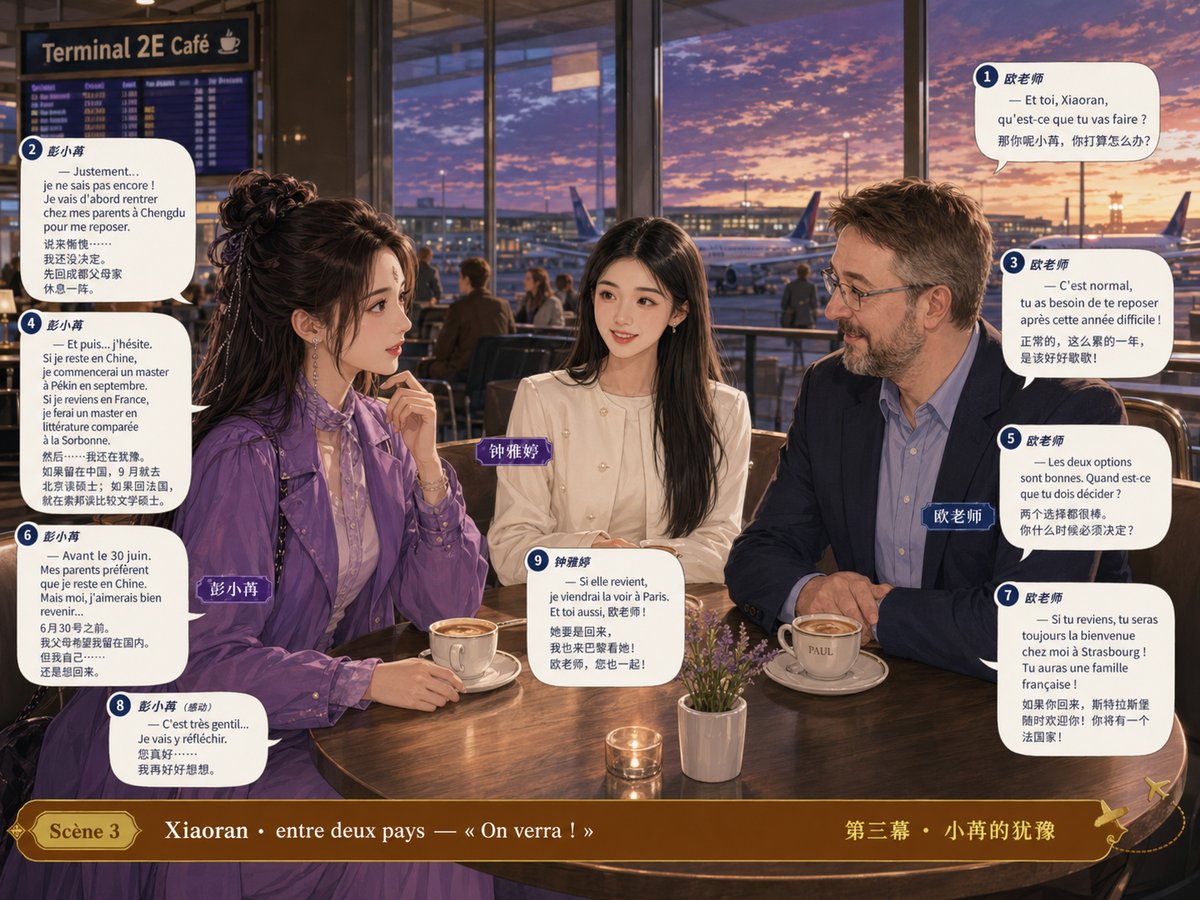
- Olivier —Et toi, Xiaoran, qu'est-ce que tu vas faire ? And you, Xiaoran, what are you going to do?
- Xiaoran —Justement… je ne sais pas encore ! Je vais d'abord rentrer chez mes parents à Chengdu pour me reposer. Well… I don't know yet! First I'll go home to my parents in Chengdu to rest.
- Olivier —C'est normal, tu as besoin de te reposer après cette année difficile ! That's fair — you need a break after such a tough year!
- Xiaoran —Et puis… j'hésite. Si je reste en Chine, je commencerai un master à Pékin en septembre. Si je reviens en France, je ferai un master en littérature comparée à la Sorbonne. And then… I'm torn. If I stay in China, I'll start a master's in Beijing in September. If I come back to France, I'll do a master's in comparative literature at the Sorbonne.
- Olivier —Les deux options sont bonnes. Quand est-ce que tu dois décider ? Both options are good. When do you have to decide?
- Xiaoran —Avant le 30 juin. Mes parents préfèrent que je reste en Chine. Mais moi, j'aimerais bien revenir… Before June 30th. My parents would prefer I stay in China. But I'd really like to come back…
- Olivier —Si tu reviens, tu seras toujours la bienvenue chez moi à Strasbourg ! Tu auras une famille française ! If you come back, you'll always be welcome at my place in Strasbourg! You'll have a French family!
- Xiaoran (moved) —C'est très gentil… Je vais y réfléchir. That's very kind… I'll think about it.
- Yating —Si elle revient, je viendrai la voir à Paris. Et toi aussi, Olivier ! If she comes back, I'll come see her in Paris. And you too, Olivier!
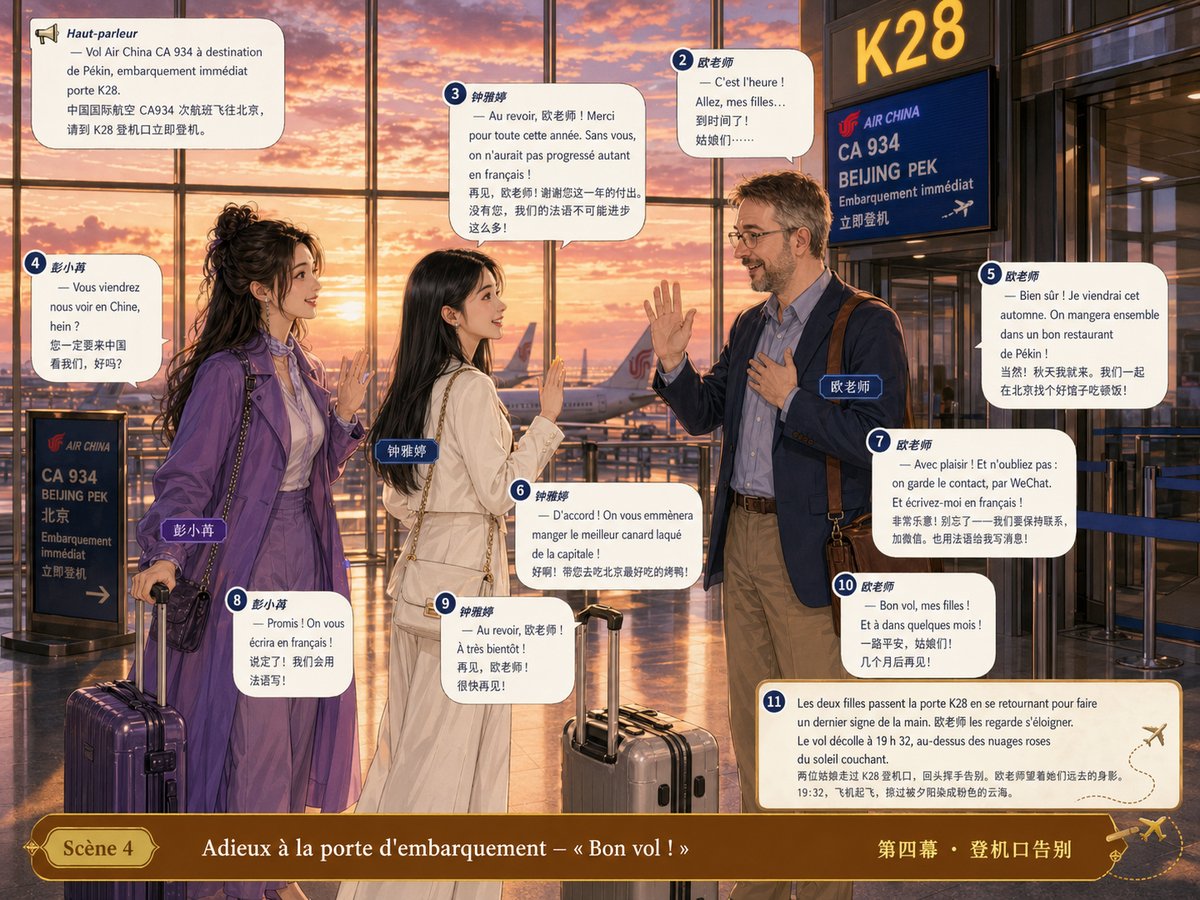
- Speaker (PA) —Vol Air China CA 934 à destination de Pékin, embarquement immédiat porte K28. Air China flight CA 934 to Beijing, immediate boarding at gate K28.
- Olivier —C'est l'heure ! Allez, mes filles… It's time! Come on, girls…
- Yating —Au revoir, Olivier ! Merci pour tout cette année. Sans vous, on n'aurait pas progressé autant en français ! Goodbye, Olivier! Thank you for everything this year. Without you, we wouldn't have made nearly as much progress in French!
- Xiaoran —Vous viendrez nous voir en Chine, hein ? You'll come and visit us in China, right?
- Olivier —Bien sûr ! Je viendrai cet automne. On mangera ensemble dans un bon restaurant de Pékin ! Of course! I'll come this autumn. We'll eat together at a good restaurant in Beijing!
- Yating —D'accord ! On vous emmènera manger le meilleur canard laqué de la capitale ! Deal! We'll take you to eat the best Peking duck in the capital!
- Olivier —Avec plaisir ! Et n'oubliez pas : on garde le contact, par WeChat. Et écrivez-moi en français ! Gladly! And don't forget: stay in touch, on WeChat. And write to me in French!
- Xiaoran —Promis ! On vous écrira en français ! Promise! We'll write to you in French!
- Yating —Au revoir, Olivier ! À très bientôt ! Bye, Olivier! See you very soon!
- Olivier —Bon vol, mes filles ! Et à dans quelques mois ! Have a great flight, girls! See you in a few months!
- (narration) —Les deux filles passent la porte K28 en se retournant pour faire un dernier signe de la main. Olivier les regarde s'éloigner. Le vol décolle à 19 h 32, au-dessus des nuages roses du soleil couchant. The two girls go through gate K28, turning to wave one last time. Olivier watches them disappear. The flight takes off at 19:32, above the pink clouds of the setting sun.
- Olivier (to himself) —Quelles belles élèves… Maintenant, elles sont aussi mes amies. À bientôt, mes filles ! What wonderful students… Now they're also my friends. See you soon, girls!
3 new words
The last new words!The very last new vocabulary at A1! Everything else here comes from Lessons 33-36 (Unit 9) and earlier units.
-
un vol
n.m.
a flight (plane)
A flight, a journey by plane. "Le vol Air France 132 part à 19 h 10."
⚠️ Heads up: un vol can also mean "a theft / robbery". Context tells you which! In airport context, it's always "flight".
Ex.: Notre vol est à 19 h 25. "Our flight is at 7:25 pm." -
une porte d'embarquement
n.f.
boarding gate
The place in the airport where you board the plane. Numbered with letter + digit: K28, A12… Often shortened to just "la porte" ("the gate").
Ex.: Embarquement immédiat porte K28. "Immediate boarding at gate K28." -
garder le contact
phrase
to keep in touch / stay in touch
To keep communicating with someone over distance. Synonyms: rester en contact, donner des nouvelles, prendre des nouvelles.
Ex.: On garde le contact par WhatsApp !
💡 Bonus airport & goodbye expressions:
- Bon vol ! "Have a good flight!" (specific to plane travel)
- Bon retour ! "Safe trip back!" (wish for the journey home)
- Bon voyage ! "Have a good trip!" (general)
- Prends soin de toi ! "Take care of yourself!"
- À très bientôt ! "See you very soon!"
- Donne-moi de tes nouvelles ! "Keep me posted!" (lit. "give me your news")
- L'enregistrement = check-in · le contrôle de sécurité = security · le passeport = passport · la valise = suitcase · un bagage à main = carry-on
Did you follow?
ComprehensionTrue or false? Vrai ou faux ?
1. Olivier comes from Paris to say goodbye.
2. The two students' flight leaves at 19:25.
3. Olivier gives them a book by Victor Hugo.
4. Yating is going to work in fashion in Shanghai.
5. Xiaoran has already decided about her master's.
6. If Xiaoran returns to France, she'll go to the Sorbonne.
7. Olivier promises to come to China this autumn.
8. They're going to keep in touch via WeChat.
Pick the right answer
- Which terminal are the girls in?
- What's the flight number?
- What's the boarding gate?
- Where is Xiaoran from?
- What will Olivier eat in Beijing?
- What gift does Olivier give the girls?
- By what date does Xiaoran have to decide?
Find the futur simple verb
Re-read the dialogue and fill in with the futur simple.
- "Vous le dans l'avion." (lire — vous)
- "Je à travailler le 1er juillet." (commencer — je)
- "Tu parler français tous les jours." (pouvoir — tu)
- "Je un master à la Sorbonne." (faire — je)
- "Tu toujours la bienvenue chez moi." (être — tu)
- "Je cet automne." (venir — je)
- "On ensemble à Pékin." (manger — on)
- "On vous manger du canard laqué." (emmener — on)
Roissy-CDG & goodbyes
Cultural notes✈️ Europe's 2nd-busiest airport
Paris-Charles-de-Gaulle airport (IATA code CDG), also called Roissy, sits 25 km north-east of Paris. With around 70 million passengers a year, it's Europe's 2nd-busiest airport (after London-Heathrow).
- It's named after Général Charles de Gaulle (1890-1970), one of the major figures of 20th-century France — wartime resistance leader, president, founder of the Fifth Republic.
- 3 main terminals: T1 (the famous circular 1970s architecture), T2 (the largest, with sub-terminals 2A through 2G), T3 (low-cost).
- T2E is the terminal for long-haul international flights: flights to China, Asia, North America.
- Connected to central Paris by the RER B train (45 min to Châtelet — much like the UK's Heathrow Express or NYC's AirTrain) and the CDG VAL (free shuttle between terminals).
- Direct flights to many countries including the US (JFK, LAX, ORD…), UK (LHR), China (PEK, PVG, CAN, HKG, CTU…), Australia (via SIN), South America, Africa.
If you fly to France from English-speaking countries, you'll most likely land at CDG (or Orly for some European/budget flights).
👋 French goodbyes
In French, you say "au revoir" in almost all situations. But there are nuances:
- Au revoir! = "Goodbye" — neutral, universal.
- À bientôt! = "See you soon!" (when you'll meet up again soon)
- À très bientôt! = "See you very soon!"
- À plus tard! / À plus! = "See you later!" (informal)
- À demain! = "See you tomorrow!" / À ce soir! = "See you tonight!"
- Salut! can mean BOTH "hi" AND "bye" between friends — context decides! (Surprising for English speakers.)
- Adieu! = "Farewell" — much rarer and dramatic. Avoid except in special cases (it suggests you'll never meet again).
- Bonne continuation! = "All the best for what's next!" — when leaving a job/course (no real direct English equivalent).
- Bon courage! = "Good luck!" / "Hang in there!" — for someone facing an effort/difficulty.
🤝 Bise, handshake, or hug?
When saying goodbye, you can:
- Faire la bise (cheek kisses) — between friends, family, or colleagues you know well. 2 kisses in Paris, sometimes 3 or 4 in some regions! Start with the right cheek (your right). Air-kissing — lips don't actually touch the cheek.
- Se serrer la main (shake hands) — between colleagues, or with a teacher. More formal. The French handshake is shorter and firmer than the American one.
- Faire un signe de la main (wave) — at a distance, or in a group.
- Faire un câlin (hug) — between close friends/family, especially in emotional moments like a long-term goodbye. Note: hugs are LESS common in France than in the UK/US/Australia. The default is the bise.
⚠️ Between teacher and student, generally no bise or hug. A handshake or a wave is the norm. But after a year together, emotion can make exceptions!
🇬🇧🇺🇸 vs 🇫🇷: in the UK/US, a handshake or hug is the default. In France, the bise is — and not knowing how to do it can be awkward (do you go left or right first? Two or three kisses?). When in doubt, follow the French person's lead.
💡 Did you know?
- Jacques Prévert (1900-1977) — hugely popular French poet. His collection Paroles (1946) is one of the bestselling poetry books in France. Many French children learn his poems at school: Pour faire le portrait d'un oiseau ("To paint a portrait of a bird"), Le cancre ("The dunce"), Déjeuner du matin ("Breakfast")…
- Peking duck (canard laqué) 🦆 is famously loved by French visitors to China! Many French chefs are big fans of the dish.
- WeChat (微信) is the Chinese equivalent of WhatsApp + Facebook + PayPal rolled into one. In France, people mostly use WhatsApp, Messenger, Instagram. If you visit China, you'll need WeChat — it's essential.
Bravo!
You made it💌 A note from your teacher Olivier:
Bravo! You've just wrapped up A1 French. That's a big milestone — by the CEFR scale, you can now:
- ✅ Introduce yourself and your family
- ✅ Understand simple sentences about everyday life
- ✅ Go shopping, make appointments, travel
- ✅ Talk about your tastes, plans, holidays
- ✅ Tell stories in the past (passé composé + imparfait + passé récent)
- ✅ Talk about the future (present / futur proche / futur simple)
- ✅ Understand French culture: geography, holidays, cinema, food…
🎯 Keep practising:
- 🎬 Watch French films with English subtitles (Intouchables, Amélie, La Famille Bélier, Le Fabuleux Destin d'Amélie Poulain…)
- 🎵 Listen to French music (Stromae, Édith Piaf, Indila, Aya Nakamura, Christine and the Queens…)
- 📖 Read graphic novels (Astérix, Tintin, Le Petit Nicolas…)
- 👫 Find a French-speaking pen pal (Tandem, HelloTalk apps)
- 🇫🇷 Travel to France if you can!
- 📱 Try the apps RFI Apprendre le français or TV5 Monde — Apprendre le français
🇫🇷 Français ❤️ English speakers 🇬🇧🇺🇸🇨🇦🇦🇺
Thanks for travelling through A1 with us.
Now go and use your French in the wild!
— Olivier, your French teacher —