The setting
Where and whoCharacters: Olivier is in Bordeaux for the weekend with two Chinese friends visiting France. Meng Ziyi (孟子义) is a literature student in Beijing, Wang Churan (王楚然) is her best friend, doing a 6-month internship in Paris. They're discovering Bordeaux for the first time! Meng Ziyi and Wang Churan are well-known Chinese actresses; the bonus chapters feature them as guest characters. As an English-speaking learner you don't need to know who they are — just enjoy the dialogue.
Olivier
The site's narrator, a Strasbourgeois by adoption, in town for the weekend. He loves the Sunday paper and a good café.
Meng Ziyi · 孟子义
Literature student in Beijing. Curious — loves stories and the culture pages.
Wang Churan · 王楚然
On a 4-month internship in Paris. Bubbly — prefers the news in brief, especially animal stories!
The dialogue
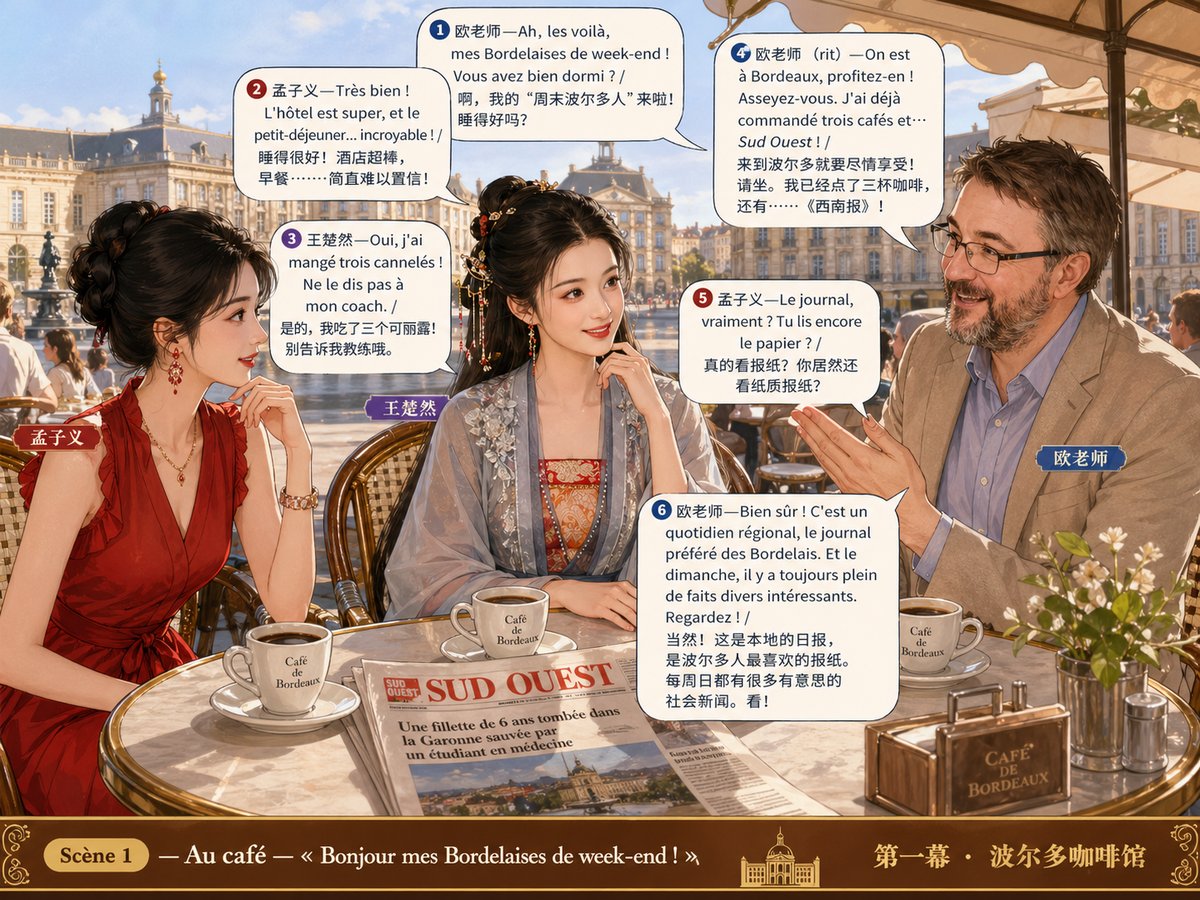
Read along- Olivier —Ah, les voilà, mes Bordelaises de week-end ! Vous avez bien dormi ? Ah, there they are, my weekend Bordelaises! Did you sleep well?
- Meng Ziyi —Très bien ! L'hôtel est super, et le petit-déjeuner… incroyable ! Very well! The hotel is great, and the breakfast… incredible!
- Wang Churan —Oui, j'ai mangé trois cannelés ! Ne le dis pas à mon coach. Yeah, I had three cannelés! Don't tell my coach.
- Olivier (laughs) —On est à Bordeaux, profitez-en ! Asseyez-vous. J'ai déjà commandé trois cafés et… Sud Ouest ! We're in Bordeaux — make the most of it! Sit down. I've already ordered three coffees and… Sud Ouest!
- Meng Ziyi —Le journal, vraiment ? Tu lis encore le papier ? A newspaper, really? You still read paper?
- Olivier —Bien sûr ! C'est un quotidien régional, le journal préféré des Bordelais. Et le dimanche, il y a toujours plein de faits divers intéressants. Regardez ! Of course! It's a regional daily — the favourite paper of Bordeaux locals. And on Sunday, there's always lots of interesting faits divers. Look!
Sud Ouest
The South-West daily · Bordeaux edition · Sunday May 17Une fillette de 6 ans tombée dans la Garonne sauvée par un étudiant en médecine
Hier après-midi, vers 15 heures, sur les quais des Chartrons, Lucas (22 ans) a plongé dans le fleuve pour secourir une enfant qui jouait au bord de l'eau et avait glissé. La mère, terrifiée, a immédiatement appelé les pompiers. Le jeune sauveteur, modeste, est reparti avant l'arrivée des secours…
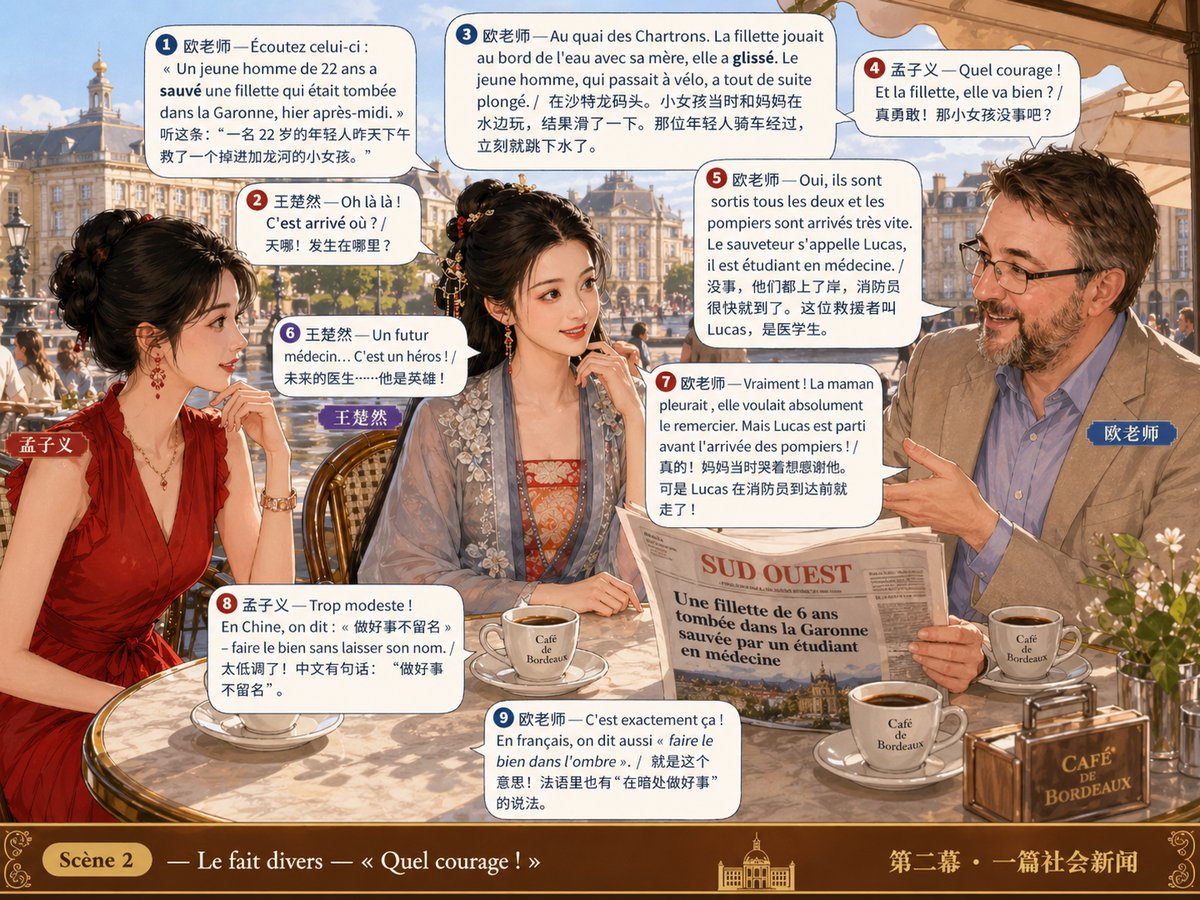
- Olivier —Écoutez celui-ci : « Un jeune homme de 22 ans a sauvé une fillette qui était tombée dans la Garonne, hier après-midi. » Listen to this one: "A 22-year-old man saved a little girl who had fallen into the Garonne yesterday afternoon."
- Wang Churan —Oh là là ! C'est arrivé où ? Oh wow! Where did it happen?
- Olivier —Au quai des Chartrons. La fillette jouait au bord de l'eau avec sa mère, elle a glissé. Le jeune homme, qui passait à vélo, a tout de suite plongé. At the Quai des Chartrons. The little girl was playing at the water's edge with her mother and slipped. The young man, who was passing by on a bike, dived straight in.
- Meng Ziyi —Quel courage ! Et la fillette, elle va bien ? How brave! And the little girl, is she OK?
- Olivier —Oui, ils sont sortis tous les deux et les pompiers sont arrivés très vite. Le sauveteur s'appelle Lucas, il est étudiant en médecine. Yes — they both got out and the firefighters arrived very fast. The rescuer is called Lucas, he's a medical student.
- Wang Churan —Un futur médecin… C'est un héros ! A future doctor… He's a hero!
- Olivier —Vraiment ! La maman pleurait, elle voulait absolument le remercier. Mais Lucas est parti avant l'arrivée des pompiers ! Really! The mother was crying, she absolutely wanted to thank him. But Lucas left before the firefighters even arrived!
- Meng Ziyi —Trop modeste ! En Chine, on dit : « 做好事不留名 » — faire le bien sans laisser son nom. Too modest! In Chinese we say "zuò hǎo shì bù liú míng" — do good without leaving your name.
- Olivier —C'est exactement ça ! En anglais, on dit aussi « a good deed done in secret », et en français, « faire le bien dans l'ombre ». That's exactly it! In English you say "a good deed done in secret"; in French we say "faire le bien dans l'ombre".
Sud Ouest
Quirky news · Bordeaux edition · Sunday May 17Un perroquet bavard retrouvé après 3 jours sur le toit du Grand Théâtre
« Coco », perroquet de 80 ans appartenant à Mme Claudine Dupont, s'était envolé samedi matin par la fenêtre. Pendant trois jours, les passants l'ont entendu crier « Bonjour mémé ! » du haut du Grand Théâtre. Récupéré hier soir par les pompiers, il mange à présent du chocolat avec sa famille adoptive d'un soir…
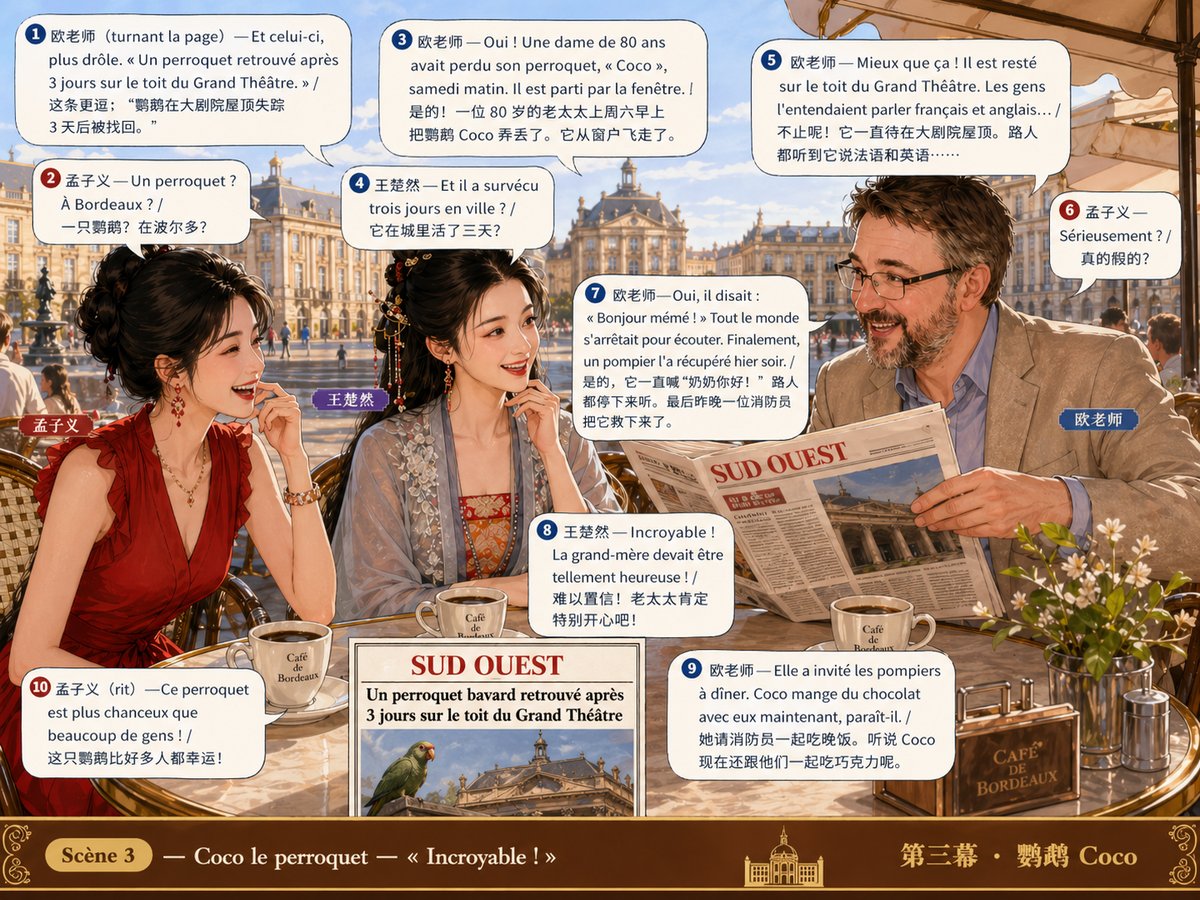
- Olivier (turning the page) —Et celui-ci, plus drôle. « Un perroquet retrouvé après 3 jours sur le toit du Grand Théâtre. » And this one's funnier. "Parrot found after 3 days on the roof of the Grand Théâtre."
- Meng Ziyi —Un perroquet ? À Bordeaux ? A parrot? In Bordeaux?
- Olivier —Oui ! Une dame de 80 ans avait perdu son perroquet, « Coco », samedi matin. Il est parti par la fenêtre. Yes! An 80-year-old lady had lost her parrot, "Coco", on Saturday morning. It flew out the window.
- Wang Churan —Et il a survécu trois jours en ville ? And it survived three days in the city?
- Olivier —Mieux que ça ! Il est resté sur le toit du Grand Théâtre. Les gens l'entendaient parler français et anglais… Better than that! It stayed on the roof of the Grand Théâtre. People could hear it speaking French and English…
- Meng Ziyi —Sérieusement ? ! Seriously?!
- Olivier —Oui, il disait : « Bonjour mémé ! » Tout le monde s'arrêtait pour écouter. Finalement, un pompier l'a récupéré hier soir. Yes, it kept saying "Hello, granny!" Everyone would stop to listen. In the end a firefighter got it down last night.
- Wang Churan —Incroyable ! La grand-mère devait être tellement heureuse ! Incredible! The grandma must have been so happy!
- Olivier —Elle a invité les pompiers à dîner. Coco mange du chocolat avec eux maintenant, paraît-il. She invited the firefighters to dinner. And apparently Coco is now eating chocolate with them.
- Meng Ziyi (laughs) —Ce perroquet est plus chanceux que beaucoup de gens ! That parrot is luckier than a lot of people!
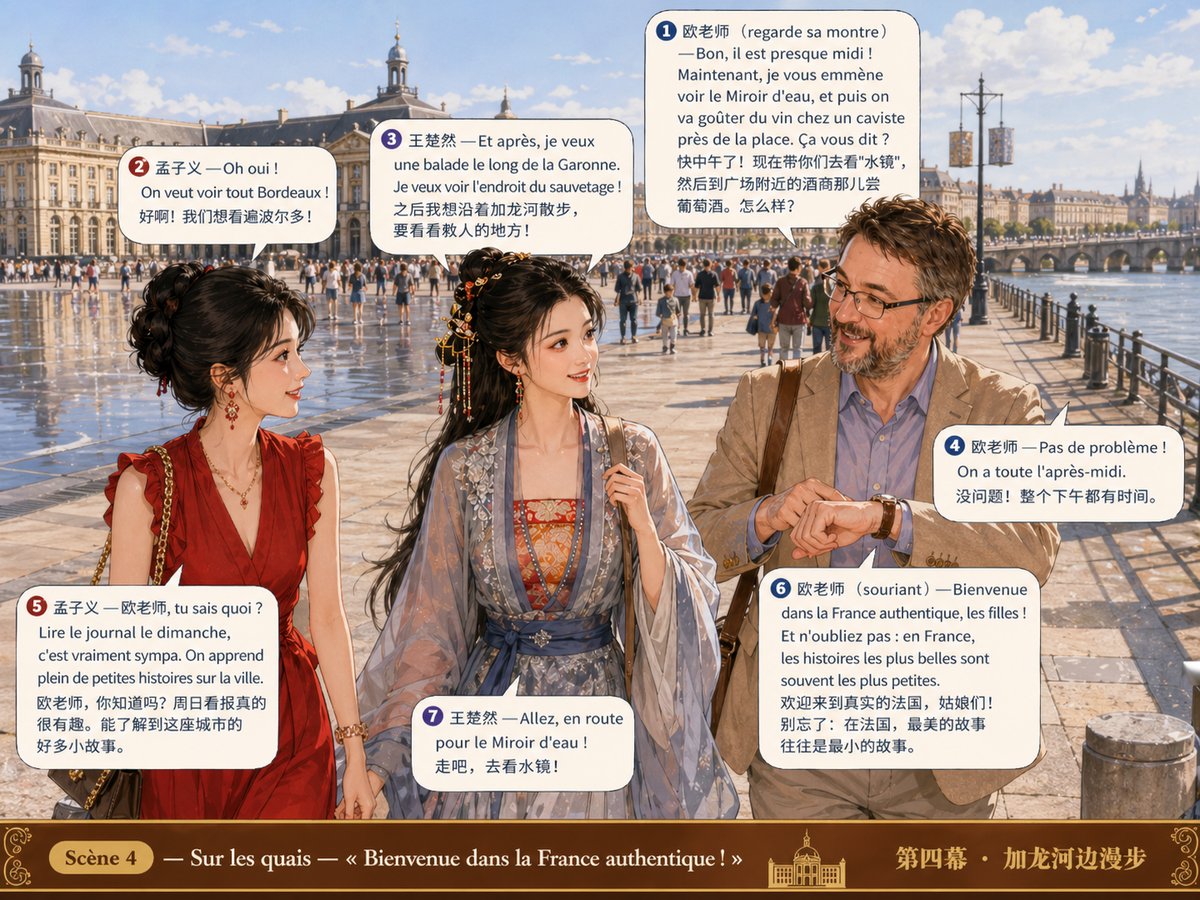
- Olivier (looks at his watch) —Bon, il est presque midi ! Maintenant, je vous emmène voir le Miroir d'eau, et puis on va goûter du vin chez un caviste près de la place. Ça vous dit ? OK, it's almost noon! Now I'll take you to see the Miroir d'eau, and then we'll taste some wine at a wine merchant's near the square. How does that sound?
- Meng Ziyi —Oh oui ! On veut voir tout Bordeaux ! Yes please! We want to see all of Bordeaux!
- Wang Churan —Et après, je veux une balade le long de la Garonne. Je veux voir l'endroit du sauvetage ! And afterwards I want a walk along the Garonne. I want to see the spot where the rescue happened!
- Olivier —Pas de problème ! On a toute l'après-midi. No problem! We've got the whole afternoon.
- Meng Ziyi —Olivier, tu sais quoi ? Lire le journal le dimanche, c'est vraiment sympa. On apprend plein de petites histoires sur la ville. Olivier, you know what? Reading the paper on Sunday is really nice. You learn so many little stories about the city.
- Olivier (smiling) —Bienvenue dans la France authentique, les filles ! Et n'oubliez pas : en France, les histoires les plus belles sont souvent les plus petites. Welcome to the real France, ladies! And don't forget: in France, the most beautiful stories are often the smallest ones.
- Wang Churan —Allez, en route pour le Miroir d'eau ! Come on, off to the Miroir d'eau!
3 new words
Just three to learnAll the rest of the vocabulary comes from Lessons 29 to 32 (Unit 8) and earlier units.
-
un quotidien
n.m.
a daily (newspaper)
A newspaper that comes out every day. French national dailies: Le Monde, Le Figaro, Libération. Regional ones: Sud Ouest, Ouest-France, Le Parisien. False-friend alert: quotidien can also be a noun meaning "everyday life" — context tells you which.
Ex.: Sud Ouest est un quotidien régional. -
un sauveteur / une sauveteuse
n.
a rescuer
A person who saves someone in danger. Distinct from un sauveur ("a saviour", more religious / heroic). Verb: sauver = "to save" (j'ai sauvé, tu as sauvé…).
Ex.: Le sauveteur s'appelle Lucas, il est étudiant en médecine. -
incroyable
adj.
incredible, unbelievable
An adjective of amazement, very useful when reacting to a story. Synonyms: extraordinaire, étonnant, surprenant, dingue (slang). Same root as English "incredible" — a true cognate, easy to remember.
Ex.: Quoi ? Un perroquet qui parle ? Incroyable !
💡 Bonus reaction expressions:
- Quel courage ! "How brave!"
- Sérieusement ? ! "Seriously?!"
- Pas possible ! "No way!"
- Tu plaisantes ? "Are you kidding?"
- C'est dingue ! "That's crazy!" (slang)
- Oh là là ! "Oh wow!" (mild surprise — much less dramatic than English speakers think; more like "oh dear" or "wow")
Comprehension
Did you follow?True or false? Vrai ou faux ?
1. Olivier and his friends are in Paris.
2. Wang Churan is doing an internship in Paris.
3. The newspaper they're reading is Le Monde.
4. The rescuer is named Lucas and he's a medical student.
5. The little girl fell into the sea.
6. Lucas stayed to receive the mother's thanks.
7. Coco the parrot stayed 3 days on the roof of the Grand Théâtre.
8. Coco spoke French and English.
Pick the right answer
- What day are the friends meeting at the café?
- What did Wang Churan eat for breakfast?
- How old is Lucas, the rescuer?
- How did Lucas save the little girl?
- How old is Coco the parrot?
- What was Coco saying from the roof?
- What are the friends going to do after the café?
Bordeaux & the French press
Setting and context🍷 Bordeaux, the pearl of Aquitaine
Bordeaux is the 9th biggest city in France, on the banks of the Garonne, in the Nouvelle-Aquitaine region. It's the world capital of wine: nearly 6,000 wine estates in the area!
- 🏛️ Place de la Bourse (1755) — an 18th-century masterpiece.
- 💧 Le Miroir d'eau (since 2006) — the world's largest reflecting pool, right in front of Place de la Bourse.
- 🍷 La Cité du Vin — a modern museum dedicated to wine (since 2016).
- 🍰 Les cannelés — small Bordeaux cake with a caramelised crust and tender heart, flavoured with rum and vanilla.
- 🦪 Arcachon oysters — famous all over France, from the nearby Arcachon Bay.
- 🏰 The vineyards around Bordeaux: Médoc, Saint-Émilion (UNESCO), Pomerol, Sauternes…
📰 The French press
What papers do French people read?
- National dailies: Le Monde (centre-left, serious, founded 1944 — roughly the FR equivalent of the New York Times), Le Figaro (right-leaning), Libération (left-leaning, founded 1973), L'Équipe (100% sport).
- Regional dailies: Ouest-France (the most-read paper in France!), Le Parisien, Sud Ouest, La Voix du Nord, Le Progrès (Lyon).
- Weeklies: L'Obs, L'Express, Le Point, Paris Match (celebrity / human-interest).
- Women's magazines: Elle, Marie Claire, Vogue Paris, Madame Figaro.
- Satirical: Le Canard enchaîné ("The Chained Duck", since 1915 — a beloved weekly of investigative journalism and political humour, somewhere between Private Eye and The Onion), Charlie Hebdo.
One thing that surprises Anglo readers: a French paper of record like Le Monde publishes its main edition in the afternoon (the date on the masthead is tomorrow's date). And there is no big Sunday paper in France the way the New York Times Sunday edition or the UK Sunday papers exist — the Sunday read is usually the regional paper or a weekly magazine.
📑 Sections of a French paper
The standard rubriques ("sections") you'll find in almost any French paper:
- La une — the front page, with the headlines.
- Politique — government news, elections.
- International — world news.
- Économie — markets, companies, jobs.
- Société — society topics, education, health.
- Faits divers — news in brief: accidents, crimes, rescues, quirky stories. (The "human-interest" page.)
- Culture — film, books, exhibitions, music.
- Sports — all the results.
- Météo — the weather forecast.
- Petites annonces — classifieds: jobs, real estate, cars…
💡 Did you know? Sud Ouest is a real paper, around since 1944. About 800,000 people read it every day in south-western France (Bordeaux, Périgueux, Bayonne, La Rochelle…). Website: sudouest.fr.